Sunday, September 25, 2016

Punic War Musings

Some sources:


Putting out the battlefield.


A bit like Trebbia...


The Romans cross the river...


Closing the gap


I glued my four stand units to single 120mm wide hardboard stands, this is a temporary measure as I plan to rebase (again) the entire collection to 80mm x 25-60mm to go for that Impetus look.


A String of Records

My training for the Merced half is going well.


And then...


And before that...


Finally...


During my last tempo run of 7 miles I posted 4 sub-8 minute miles, and 8:03 and well, there was a nature calls break that ruined that time.  But my pace is definitely starting to look sub-8ish.  Dare I hope for a sub 1 hour 45 minute half?


Battle of Three Rivers

For my birthday I put out the War of Spanish Succession figures again.  I need to break them in.  Mostly I just played about with my terrain until I felt I had something interesting.  The aerial view:


French on the bottom, the more numerous Austrians at the top of the photo.  French win if Austrians can't break them and cause them to leave the battle field.  Eugene commanded the Austrians, the French had Tallard.  The larger river was very difficult to cross except for at the bridges.


The Palatinate attempted the impossible.


The Austrians would ultimately force the bridge with the help of their Prussians (top left corner).  On the other side of the board the French Cavalry would hold one hill, while an Austrian command held another, and the third Austrian command came across the bridge to "pincer" the French Cavalry.  The French in the Town merrily shot away at the Austrians on the hill, but eventually would come out to help the beleaguered cavalry.


Beyond the bridge as seen on the left, the French made a final stand on a nearby hill and ultimately threw back the Prussian and Palatinate attackers.  With losses mounting, the Austrian army quit the field (lost a major morale check).  It was a close battle with both sides low near zero on morale chips.  The battle of the "Hill bridge" was the deciding factor.


Thursday, August 11, 2016

Big Bottoms

"If you want big bases, my miniatures got'em"

This transition started percolating in my brain during the last Roman-Carthaginian clash.  I was using the "Pulse of Battles" rules and I realized that the only reason I was using multiple bases for a unit was to turn one stand backward to indicate disordered.  Otherwise, having multiple bases was just a hassle for my players.  In the past I even had people trying to move all four stands at once and tumbling a couple of bases across the landscape..."shudder."

Then I started rebasing my world war II stuff for Field of Battle WW2.  I enjoyed the effect of mixing riflemen, machine guns, and mortars to create a diorama meant to represent a company of troops.  The concept of a base being a unit (company, battalion, brigade whatever) appeals to me.  Being able to put everything I need to know about that unit on that base in an inconspicuous way also seems the best way to go.

I started looking online figuring I couldn't be the only person thinking about this, perhaps others had already tried it out?

I found that Brent Oman toyed with this idea during the "Pulse of Battle" development.  It is somewhere in his blog "Wargames and Stuff"  He mentioned issues with bent swords and spears, or something like that.  Undaunted I continued looking and found "Impetus."

Wow! 120mm bases for 28mm and 80mm bases for 15s.  I figured 120mm base had to be the max for 28mm just from weight alone.  I so I rebased my very small War of Spanish Succession collection, and finally finished painting enough of them to put on the table.

Each unit is a "combat effective."  If it helps you can think of them as regiments or groups of battalions.  I don't care.  They have flags, because this seems important and adds to the look I am striving for.  Some of the units are quite old.  I started this project almost 20 years ago.  The first units have wine bottle lead flags, the newer stuff is rice paper flags.

The French and Austrians face off!  The French are defending the little town of hobbit folk (10mm buildings as I wait to build a 28mm town?).


French Cavalry Charging hapless Austrian infantry.


And a close up of La Reine


Lyonnaise on the move


None shall harm the hobbit folk here!


Regiments Navarre and Dauphin


Wendt destroying silenced French artillery.


Why were they silent?  Austrian artillery counter battery fire!

Another look at French cavalry in action.


I had bought 8 cavalry for each unit at the start of this project, but on 120mm bases, 8 Front Rank cavalry would not fit.  As it was I had to stagger them on a deeper base for La Reine to get them to fit.  It looks really cool, but the base are heavy, and will require extra care when handling.

For me bases have become units and decorated (expensive) playing pieces.  It also works better for my meager 5x9 foot playing space.

I'm currently rebasing my15mm Egyptian and Hittite armies.  For these I'm going with 90mm bases because I can fit three chariots on one of these for a "unit" effect.  I bought command figures for my infantry to expand those units to 14 figures per 90mm base.  Close order infantry will be put at 30 mm depth, and light infantry (skirmish) on 40mm depth.

My online searches caused me to stumble upon Altar of Freedom.  I love the large scope battles, where you try to put an entire Civil War battle on the table, not just a part of it.  I tried it for 28mm WSS, but it didn't work for me, so I am scaling Field of Battle to 75 yards to an inch.  This should allow me to get Blenheim onto my table.  I've been play testing a few modifications using the above set-up, and things are coming along nicely.

I think I will return to Altar of Freedom for American Civil War (ACW), but with 10mm figures (to go with hobbit houses). I love the idea of the Priority Point system, it just isn't very solo player friendly. ACW will probably be my next project for sometime next year?  So much painting to do, so little time.

Sunday, July 17, 2016

Ham and Bacon

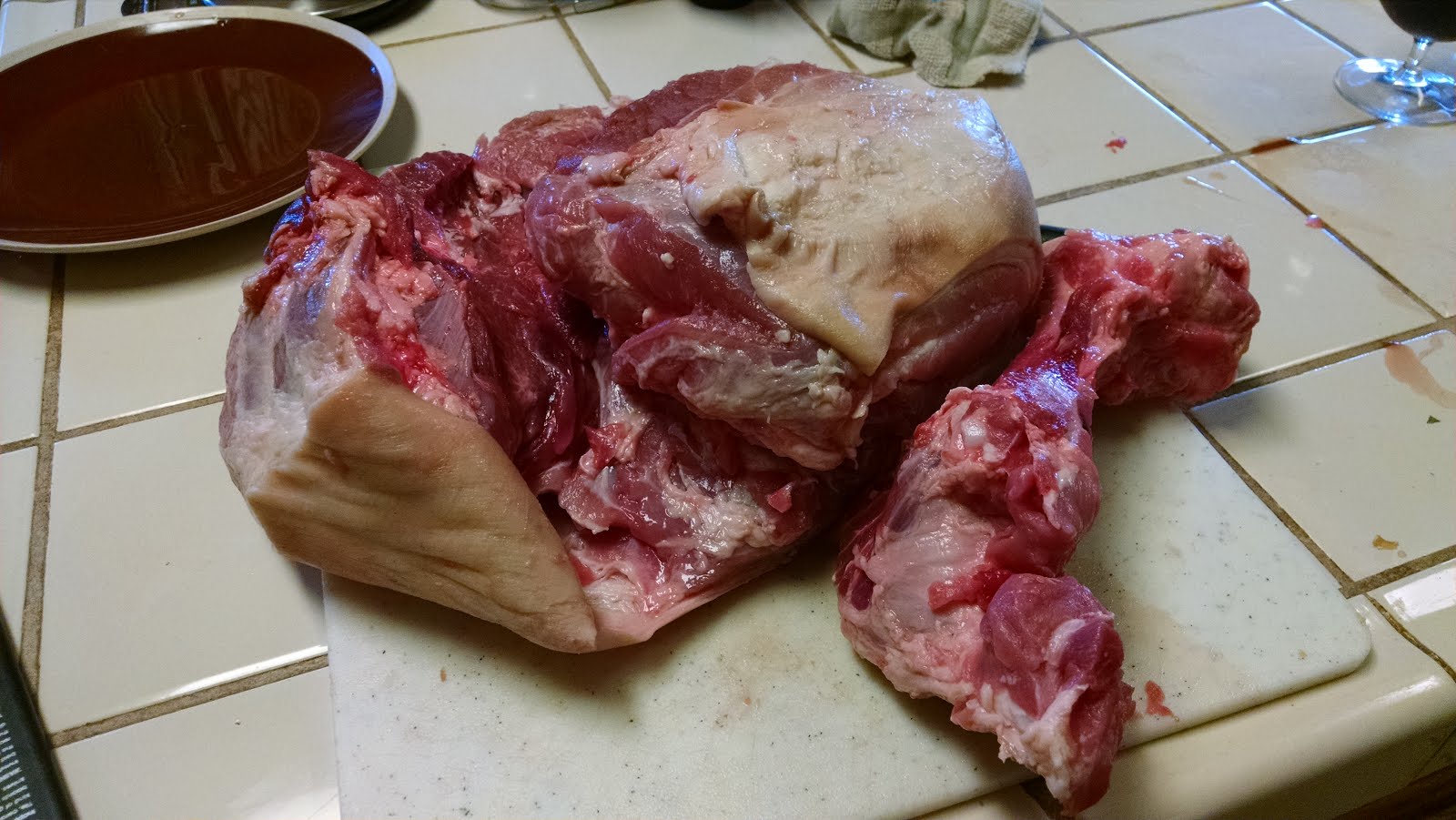
I took the remaining ham of our Berkshire pig and removed the bone.


Looks like I got a good soup bone out of the deal.   Notice the skin is still on the ham.  I put the boneless ham into an equilibrium cure of about 3% salt, 1.5% brown sugar, 0.25% pink salt, some smoked paprika and white pepper.  All of it went into a plastic bag and rolled around for a couple of weeks - I turned it every day.

I then took the ham and bagged it up in a proper mesh bag.  I sprayed it with Bactoferm 600 to get some good mold growing to keep bad mold at bay.  I purchased a new curing chamber, aka beverage refrigerator for this project.  I equipped it with a temperature control set at 52 degrees, and add my humidity pan to keep it at 75% humidity.

Now I have to wait until November, sigh.  But it is looking pretty good so far.


I love Berkshire bacon.  The ratio of muscle to fat is just incredible.  It is so easy to do, and the cold smoking with applewood really makes it shine.  I tried making it without pink salt and the color was just too off, so I put the pink salt back into the recipe and ...


Sunday, June 5, 2016

Two 5Ks

My first race was a 5k.  That was the local Mother's Day race.  That was a very windy day, and I ran it in 30 minutes 40 seconds.  I read somewhere (and therefor it must be true, right?) that people who run longer distances (marathoners and ultra-marathoners) will train for shorter races in order to improve speed, speed that improves even their longer distance times.

After Modesto I decided to test this idea and train for a 5k.  I signed up for a race in June that gave me the most time to train before race day.  I also signed up for a race in May just because a friend was running it.  My goal was to best 25minutes.  I had never done that before, but had run a 25:09 during the Modesto Half.  It should be easy to beat 25 minutes, right?

I didn't have any training plans for a 5k, so I picked up a couple of books.


Both had 5k training plans.  I picked up the one on the left because, well, I want to run faster, duh!  I picked the "Run Less, Run Faster" because I like novel approaches to pretty much anything!  I actually like running, don't consider myself particularly prone to injury (where is some wood to knock on), and this book seems to be for people not in the "I don't like running" or "I get hurt a lot running" categories.  I read it and came away with the same conclusion as the no-meat-athlete.  However, the book sort of required a 5k time in order to figure out training paces.  I could use the 25:09, but I thought since I ran that during a half-marathon, that I should be able to do a lot better than that.

Brad's book brought one important element into my training - hill sprints.  The only problem is that there are no hills near to where I live.  I turned to my trusty treadmill.  I'm now up to 8 x 8 second hill repeats at 9.2 mile per hour, and an 8% incline.  I decided to build this into my Friday workout, and move my tempo training to Sunday at the beginning of my Long Run.  This seems so natural to me, and it seems to be what I was gravitating to for the last year or so.  I just don't like slower paced long runs.  They are too boring, and after a warm up I'm ready to start trying to find my race pace.  Interestingly, the Run Less book also leans towards a faster long run.

Then on April 30th, during a tempo run on Sunday:


And so I peaked early.

During the May 5k I was running with colleagues and friends.  I wasn't really ready to compete hard, or run in the now much warmer temperature. I managed a 26:09, not even half-marathon pace.  I didn't even much  taper my running the week before the race.  I did hill sprints and interval training. The day before the race I only did 3 miles, but it included 3x 100 yard dashes at maximum pace, perhaps not the smartest way to prepare for a PR.  Of course there was also that moment were me and about a dozen runners got briefly lost during the race.  That may have added to my time.

Yesterday I ran the San Jose Giants' run (5k not 5 mile option) and ran a 25:01.  This time I rested properly, but made a tactical error during the run.  I tried for negative splits, saw my second mile at 8:15 and figured I had no way to hit a PR.  However, I reached mile 3 just when I heard the announcer say we were just hitting the 24 minute mark.  It just didn't register.  I know I could have sprinted that last ~160 yards in under a minute, but I waited until I could see the finish line, barely 30 yards away as I turned the final corner.  I probably could have PR'd, but no biggy.  I finished 3rd in my age group and even a PR would not have netted me 2nd as the next guy in my age bracket was running a wicked 7:22!


On a positive note, my Garmin register a 4:30 as I came into the finish.  That is uncharted water for me.

In a week I go on vacation.  I will try to run when I can, hopefully at least every other day.  I will do some speed play to keep sharp.  We will be on the Northwest coast mostly, so it should be relatively cool.  I do enjoy running when I travel.  When I get back, the plan is to begin training for the Merced Half-Marathon using a combination of Hansen's method and Brad's hill sprinting.  I think the hill sprinting is what made the 4:30 possible.

Sunday, May 29, 2016

Havoc near the Moselle

I've been rebasing my 15mm World War II figures for Field of Battle WW2.  This is a game were every stand is a company, every 3-4 stands a battalion, and you can field multiple divisions on a game table.

My goal when I started this project was to use my available figures to build the 4th armored division of the the U.S. and a Panzergrenadier division of Germany.  I completed the 4th, and got most of the Panzergrenadier division completed - minus its recon battalion and a company of Panzers.  My interest has been mostly focused on the Encirclement of Nancy and Arracourt around September 1944.  Within that context I'm allowing myself some leeway for terrain, and stuff I've already painted to add to the mix. This After Action Report (AAR) is a hypothetical clash between elements of the U.S. 80th infantry division, and Combat Command A of the 4th Armored division, versus the 3rd Panzergrenadier division bolstered by a battalion of Tiger I's and Panthers.

The victory conditions were simple, take or hold the two villages.  The Americans had them, the Germans wanted them and were attacking.  Only two American battalions started on the board, one for each village, both with a single company of M10 tank destroyers.  The Americans had some air support and a full division worth of artillery (three medium batteries, and one heavy), while the Germans had only two medium batteries of artillery for support.  German troops were mostly rated as trained, and their leadership skilled.  The American troops were experienced and leadership rated as average.  The Tiger's were rated as veterans, and the Panthers green.

I will try to let the pictures tell the rest of the story.

Below we see the initial assault of Panthers and Panzergrenadier infantry versus an American Battalion in the village of Avant.  You only see a single company of the American Battalion.  They used opportunity fire to disorder the Panther with a "D".  If you know the rules, this is the same as suppressed.


From the Southeast Stugs with more infantry support attack.  The Germans have also placed a spotting round for artillery in this image.


Over in Le Pont the Tigers attack with two battalions of infantry support.


Combat Command A crosses the Moselle.


The German Tiger commander concerned that all of the American reinforcements are concentrating on his side of the battlefield, presses his attack.


An American Tank battalion views the now German occupied Avant in the distance.


The Americans had a slow start, only drawing a move one command card initially and rolling a leadership roll of 1 for that!  By the time the move cards started appearing, the Germans had already secured the more southern village where the bulk of their forces were located, and had advanced up to the southern bridge.  The Americans wisely choose to use the Northern bridge to attempt and overwhelm the three German Battalions attacking the larger more northern town of La Pont.  Above you can see the Panthers turning to travel back the road that connects the two urban areas in an effort to help capture the last town.

An American Battalion succeeds in its engineering roll to cross the Moselle and promptly sits there to go fishing.  You can see the aforementioned armored battalion (part of the same command group) and an attached Greyhound M8 - the only recon company on the board.


The Germans have taken about half of La Pont, including the Church.  Here a company of Germans close assaults the flank of the American reinforcements trying to enter an orchard.  The Americans were also trying to retake the Church, but the Tigers said no!


Then American artillery answered.


Here we see part of the "American Pocket" over the north Moselle.  You can also see the rest of the German forces finally making their way over to attempt and help secure La Pont.  The Panzer battalion approaching the American battalion on the hill would be wiped out.  Notice the American infantry still "fishing."


Part of the pocket, and a well placed German spotting round that would hammer the Americans that were clustered there.


The last American company in the town (above) was soon wiped out after this shot, along with the lone German company in the Church.

Arrival of American air power.


One Tiger company was lost.  Both sides ran out of Morale chips.  The Americans passed their first Morale test, but not the second.  The battle ended with the Germans occupying one town, and the other town unoccupied, a tactical German victory.


Ngorongoro

 The capstone of our visit was the Ngorongoro crater safari. On our way to the crater from Ndutu, I got this picture and the Oldovai gorge r...