Sunday, July 17, 2016

Ham and Bacon

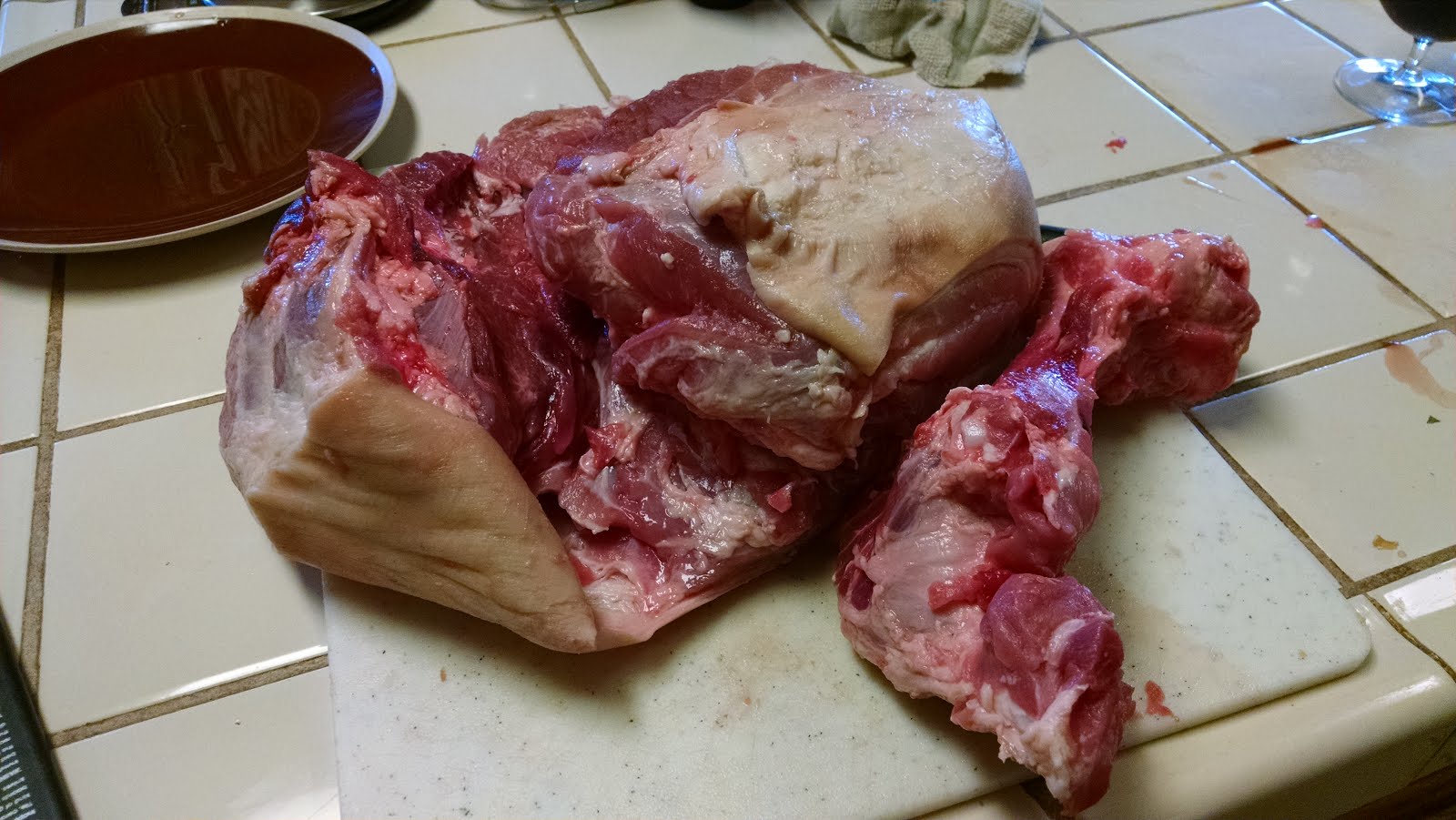
I took the remaining ham of our Berkshire pig and removed the bone.


Looks like I got a good soup bone out of the deal.   Notice the skin is still on the ham.  I put the boneless ham into an equilibrium cure of about 3% salt, 1.5% brown sugar, 0.25% pink salt, some smoked paprika and white pepper.  All of it went into a plastic bag and rolled around for a couple of weeks - I turned it every day.

I then took the ham and bagged it up in a proper mesh bag.  I sprayed it with Bactoferm 600 to get some good mold growing to keep bad mold at bay.  I purchased a new curing chamber, aka beverage refrigerator for this project.  I equipped it with a temperature control set at 52 degrees, and add my humidity pan to keep it at 75% humidity.

Now I have to wait until November, sigh.  But it is looking pretty good so far.


I love Berkshire bacon.  The ratio of muscle to fat is just incredible.  It is so easy to do, and the cold smoking with applewood really makes it shine.  I tried making it without pink salt and the color was just too off, so I put the pink salt back into the recipe and ...


Sunday, June 5, 2016

Two 5Ks

My first race was a 5k.  That was the local Mother's Day race.  That was a very windy day, and I ran it in 30 minutes 40 seconds.  I read somewhere (and therefor it must be true, right?) that people who run longer distances (marathoners and ultra-marathoners) will train for shorter races in order to improve speed, speed that improves even their longer distance times.

After Modesto I decided to test this idea and train for a 5k.  I signed up for a race in June that gave me the most time to train before race day.  I also signed up for a race in May just because a friend was running it.  My goal was to best 25minutes.  I had never done that before, but had run a 25:09 during the Modesto Half.  It should be easy to beat 25 minutes, right?

I didn't have any training plans for a 5k, so I picked up a couple of books.


Both had 5k training plans.  I picked up the one on the left because, well, I want to run faster, duh!  I picked the "Run Less, Run Faster" because I like novel approaches to pretty much anything!  I actually like running, don't consider myself particularly prone to injury (where is some wood to knock on), and this book seems to be for people not in the "I don't like running" or "I get hurt a lot running" categories.  I read it and came away with the same conclusion as the no-meat-athlete.  However, the book sort of required a 5k time in order to figure out training paces.  I could use the 25:09, but I thought since I ran that during a half-marathon, that I should be able to do a lot better than that.

Brad's book brought one important element into my training - hill sprints.  The only problem is that there are no hills near to where I live.  I turned to my trusty treadmill.  I'm now up to 8 x 8 second hill repeats at 9.2 mile per hour, and an 8% incline.  I decided to build this into my Friday workout, and move my tempo training to Sunday at the beginning of my Long Run.  This seems so natural to me, and it seems to be what I was gravitating to for the last year or so.  I just don't like slower paced long runs.  They are too boring, and after a warm up I'm ready to start trying to find my race pace.  Interestingly, the Run Less book also leans towards a faster long run.

Then on April 30th, during a tempo run on Sunday:


And so I peaked early.

During the May 5k I was running with colleagues and friends.  I wasn't really ready to compete hard, or run in the now much warmer temperature. I managed a 26:09, not even half-marathon pace.  I didn't even much  taper my running the week before the race.  I did hill sprints and interval training. The day before the race I only did 3 miles, but it included 3x 100 yard dashes at maximum pace, perhaps not the smartest way to prepare for a PR.  Of course there was also that moment were me and about a dozen runners got briefly lost during the race.  That may have added to my time.

Yesterday I ran the San Jose Giants' run (5k not 5 mile option) and ran a 25:01.  This time I rested properly, but made a tactical error during the run.  I tried for negative splits, saw my second mile at 8:15 and figured I had no way to hit a PR.  However, I reached mile 3 just when I heard the announcer say we were just hitting the 24 minute mark.  It just didn't register.  I know I could have sprinted that last ~160 yards in under a minute, but I waited until I could see the finish line, barely 30 yards away as I turned the final corner.  I probably could have PR'd, but no biggy.  I finished 3rd in my age group and even a PR would not have netted me 2nd as the next guy in my age bracket was running a wicked 7:22!


On a positive note, my Garmin register a 4:30 as I came into the finish.  That is uncharted water for me.

In a week I go on vacation.  I will try to run when I can, hopefully at least every other day.  I will do some speed play to keep sharp.  We will be on the Northwest coast mostly, so it should be relatively cool.  I do enjoy running when I travel.  When I get back, the plan is to begin training for the Merced Half-Marathon using a combination of Hansen's method and Brad's hill sprinting.  I think the hill sprinting is what made the 4:30 possible.

Sunday, May 29, 2016

Havoc near the Moselle

I've been rebasing my 15mm World War II figures for Field of Battle WW2.  This is a game were every stand is a company, every 3-4 stands a battalion, and you can field multiple divisions on a game table.

My goal when I started this project was to use my available figures to build the 4th armored division of the the U.S. and a Panzergrenadier division of Germany.  I completed the 4th, and got most of the Panzergrenadier division completed - minus its recon battalion and a company of Panzers.  My interest has been mostly focused on the Encirclement of Nancy and Arracourt around September 1944.  Within that context I'm allowing myself some leeway for terrain, and stuff I've already painted to add to the mix. This After Action Report (AAR) is a hypothetical clash between elements of the U.S. 80th infantry division, and Combat Command A of the 4th Armored division, versus the 3rd Panzergrenadier division bolstered by a battalion of Tiger I's and Panthers.

The victory conditions were simple, take or hold the two villages.  The Americans had them, the Germans wanted them and were attacking.  Only two American battalions started on the board, one for each village, both with a single company of M10 tank destroyers.  The Americans had some air support and a full division worth of artillery (three medium batteries, and one heavy), while the Germans had only two medium batteries of artillery for support.  German troops were mostly rated as trained, and their leadership skilled.  The American troops were experienced and leadership rated as average.  The Tiger's were rated as veterans, and the Panthers green.

I will try to let the pictures tell the rest of the story.

Below we see the initial assault of Panthers and Panzergrenadier infantry versus an American Battalion in the village of Avant.  You only see a single company of the American Battalion.  They used opportunity fire to disorder the Panther with a "D".  If you know the rules, this is the same as suppressed.


From the Southeast Stugs with more infantry support attack.  The Germans have also placed a spotting round for artillery in this image.


Over in Le Pont the Tigers attack with two battalions of infantry support.


Combat Command A crosses the Moselle.


The German Tiger commander concerned that all of the American reinforcements are concentrating on his side of the battlefield, presses his attack.


An American Tank battalion views the now German occupied Avant in the distance.


The Americans had a slow start, only drawing a move one command card initially and rolling a leadership roll of 1 for that!  By the time the move cards started appearing, the Germans had already secured the more southern village where the bulk of their forces were located, and had advanced up to the southern bridge.  The Americans wisely choose to use the Northern bridge to attempt and overwhelm the three German Battalions attacking the larger more northern town of La Pont.  Above you can see the Panthers turning to travel back the road that connects the two urban areas in an effort to help capture the last town.

An American Battalion succeeds in its engineering roll to cross the Moselle and promptly sits there to go fishing.  You can see the aforementioned armored battalion (part of the same command group) and an attached Greyhound M8 - the only recon company on the board.


The Germans have taken about half of La Pont, including the Church.  Here a company of Germans close assaults the flank of the American reinforcements trying to enter an orchard.  The Americans were also trying to retake the Church, but the Tigers said no!


Then American artillery answered.


Here we see part of the "American Pocket" over the north Moselle.  You can also see the rest of the German forces finally making their way over to attempt and help secure La Pont.  The Panzer battalion approaching the American battalion on the hill would be wiped out.  Notice the American infantry still "fishing."


Part of the pocket, and a well placed German spotting round that would hammer the Americans that were clustered there.


The last American company in the town (above) was soon wiped out after this shot, along with the lone German company in the Church.

Arrival of American air power.


One Tiger company was lost.  Both sides ran out of Morale chips.  The Americans passed their first Morale test, but not the second.  The battle ended with the Germans occupying one town, and the other town unoccupied, a tactical German victory.


Sunday, March 20, 2016

Modesto With a new PR!

A year ago I ran my second half-marathon and improved my time from 2 hours 7 minutes to 1 hour 54 minutes, an improvement of 13 minutes.  I knew that I couldn't expect that continued level of improvement, I didn't realize that it would take a year before I would improve on that time.

I've learned a few things since that day.

  1. Don't just keep training after such a surge in improvement. Actually, I don't think it was the continued training in running, but rather a change in gym equipment that resulted in the worst back injury I had suffered from in years.  It set my training back a lot.
  2. You don't set PR's running in warmer weather.  I just missed a sub-2 hour at "Water-to-Wine" in August, and I'm pretty sure part of that was the warmer conditions.
  3. Don't run a half-marathon in jeans.  I did run a sub-2 in my second half-marathon in Monterey, barely.
  4. Have a training plan with an end goal, and don't run more than 2 half-marathons a year.  I've been terrible about following training programs.  I've fixed into my head to run one interval day, one tempo day, and one long-run day a week without actually focusing on any specific improvement for the training sessions.  Oh, I do pretty good on all of it, but intervals.  I finally focused on following my a training program for my second attempt at Modesto,but only the last 6 weeks, but I really believe it paid off.  By trying to run 4 half-marathons last year, I missed one half-marathon, and didn't really have a enough time to properly train for any of the others.
  5. Do more research.  I've gathered some more books on half-marathon training plans.  I plan to follow one of these fairly religiously for my next half-marathon in Merced.
  6. Work on speed.  I have some 5k training plans now.  I still haven't run a full marathon because at this point I don't want to bother unless I have a shot at Boston, silly but true.  I think too many people focus on distance, getting the marathon off a bucket list instead of running it at their best possible speed.  I could be wrong, but I plan to mesh speed training for a shorter distance this spring with training for a longer run in the fall to see if I can unlock sub-8s for my running endeavors.  I had some real pay-offs in speed training for this year in Modesto, building up running efficiency.
So I backed off on the total miles somewhat.  Oh, I put in a 16.9 mile long run, and managed a couple of 60+ mile weeks to prep for Modesto 2016, but no 19 milers, or 76+ mile weeks.  I backed off of a 10 mile tempo run to a 7 mile tempo run to see if I could hold the pace that was recommended by my training book.  I moved to some strength training intervals for 3, 2, 1.5 and 1 miles for 6 miles total each.  And, I properly tapered for this attempt in Modesto.

The night before I carbed up on sea food pasta, and kept my wine intake moderate. I remembered my new Soffe shorts. I hoped for a smaller beginning crowd as they had moved the 5k event to start 20 minutes after the full and half marathons.  But it was more crowded than the previous year.  Still my first mile wasn't much off of last year at a 9:20.  After that it was mostly 8:20s and 8:30s.  I ran the rest stops, doing my best to splash water and gatorade into my mouth as I ran.  This was a departure from my first Modesto PR and subsequent races where I walked the rest stops.  I did have one port-a-potty break, number 1 only thankfully, but maybe not needed, and definitely cost me in time.

The final result was a 1 hour 51 minute and 2 second time, more than 3 minutes faster than the previous attempt.  I had hoped to break 1h50m, but will save that for Merced, I hope.  

My plan is to stick with the actual training plan, starting the day I get back from vacation in June.  This is exactly 18 weeks which is the training plan length.  I will train for 1h48m.  

I have a 5k in May as alluded to above.  I hoped to hold a sub-8minute mile pace as I break into a sub-25 minute 5k.  I really only have 6 weeks to train though - much shorter than the 12 week programs I should be following.  Oh well.


Sunday, March 13, 2016

Coffee

I sort of gave up coffee many years ago.  I was drinking too much of it and it was exacerbating my anxiety issues.  So I switched to tea.  I immediately got into loose leaf tea because that is the best tea out there.  At first I drank no coffee, and then, over the years, started to drink it whenever I went on vacation.

Recently we purchased a tear drop trailor.
I knew we would be vacationing in this, and I wanted my vacation coffee.  So I started thinking and researching online.  I discovered home roasting.

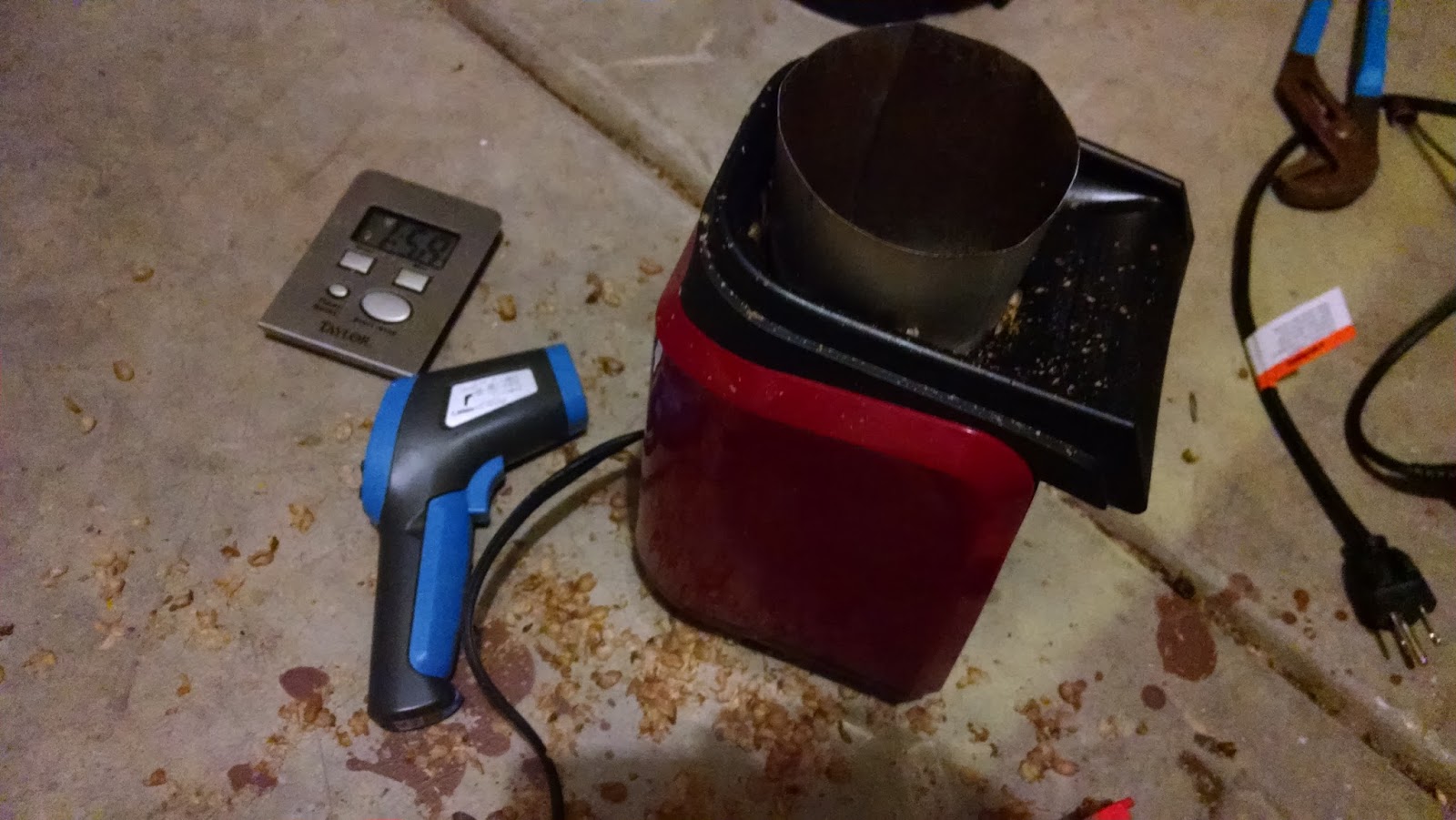
I've roasted beans in the oven, on the stove top using cast iron, using a heat gun, using a heat gun and hot plate.  My favorite way to roast is with a modified air popcorn popper.
Besides the obvious stainless steel sheet metal modification, I also bypassed the thermostat cut-off so that it can achieve temperatures high enough to get to second crack - look it up.  I can roast 85 grams in less than 4 minutes, but I usually prolong the roasting by switching the air on and off, while stirring to develop the flavors more.  So my average roasting time is closer to just shy of 8 minute.  If I want to roast a super large batch, then I need to use the hot plate/heat gun combo.

I get my beans from Sweet Maria's.
Great service, fast, wonderful selection.  Variety is the spice of life.

Grinidng:
Great little hand grinder hooked up to my drill.  I've since moved on to
It gives a more consistent expresso grind, and greater volume in case I ever need it.  I like immersion methods of brewing, but didn't want to use a coarse grind and so French Press was out.  I went with an Aeropress.  It can handle really fine grinds. I wasn't thrilled with the plastic or paper disks, so I replaced the paper with a stainless steel screen.  At least the plastic is BPA free.

Some roasted and unroasted beans:
I stopped drinking tea.  I limit myself to two cups of coffee a day, and that seems to work.  It is really good coffee, better than I ever had before.  The coffee in France, and Italy don't even come close.  If you love something enough, and you are willing to put in the effort, you can almost always achieve better results than any commercial application.

A cute dog:
A cute but camera shy dog:
Some Kimchi
The basil/cilantro combo is crazy good.
I brew beer
An Irish Ale.  Next blog post?

Friday, February 5, 2016

Monterey Half Number 2

I ran the 2015 Monterey Half-Marathon.  The 2014 Monterey half was my first half marathon run, and I ran that in 2 hours 7 minutes.  My goal this year was to beat that time, maybe the Modesto time, at least under 2 hours, please.

My wife and I love Monterey.  We often have a good time there.  Perhaps I had too good of time, perhaps one glass of wine too many?  I also forgot my running shorts.

By the time I noticed this, it was too late to purchase a pair.  At first I was going to not run.  But I really wanted my 2015 medal.  I also wanted the sub-2 hour time.  Between the wine, and now this, it seemed that I was subconsciously sabotaging my efforts to PR.  I decided to run in my jeans.


1 hour 59 minute exactly.

There were a lot of hills that I didn't remember from the first time.  My jeans were soaked in sweat by the time I finished.  There was much chaffing.  I got a new blood blister on the bottom of my foot from the effort.  I finished 1635th place out of 6559 participants.  That puts me in the top third.  I'll take it.

Changes


My running is changing.
I used to run as many as 70+ mile weeks.  I've stopped that.  I dropped down to running 60 mile weeks on occasion, and now I'm in the 49-53 mile range.  I've decided to reduce the amount of running to get more of my life back for other activities, and because I'm not actually training for a marathon.  I run half marathons.  Fifty miles a week is plenty for half marathon training.

I've also dropped 16.5 mile long runs.  Hansen's half marathon book suggests 14 mile long runs, every other week or so.  I have a route that does 13.8 miles.  I like that.  I'm thinking every other week I will run it with the goal of finishing in under 2 hours.  If I can manage that, then I will always be able to run my races in under 2 hours.  That would be sufficient.

Insert Long Blogging Break Here

So I started this post many months ago.  In that time David Bowie died, and I started carrying a water bottle on my runs instead of relying on the water fountains along the canal.  I'm sad about David.  I'm able to change up where I run.  I've done a couple of 16 mile runs.

I started taking peanut butter cookies with mini-chocolate chips on my runs.


Probably not the healthiest running food, but it sure is motivating.  The recipe is basically your classic peanut butter cookie with mini-chocolate chips mixed in.  I also beef up the salt slightly for salt replacement during the run.

Ngorongoro

 The capstone of our visit was the Ngorongoro crater safari. On our way to the crater from Ndutu, I got this picture and the Oldovai gorge r...